

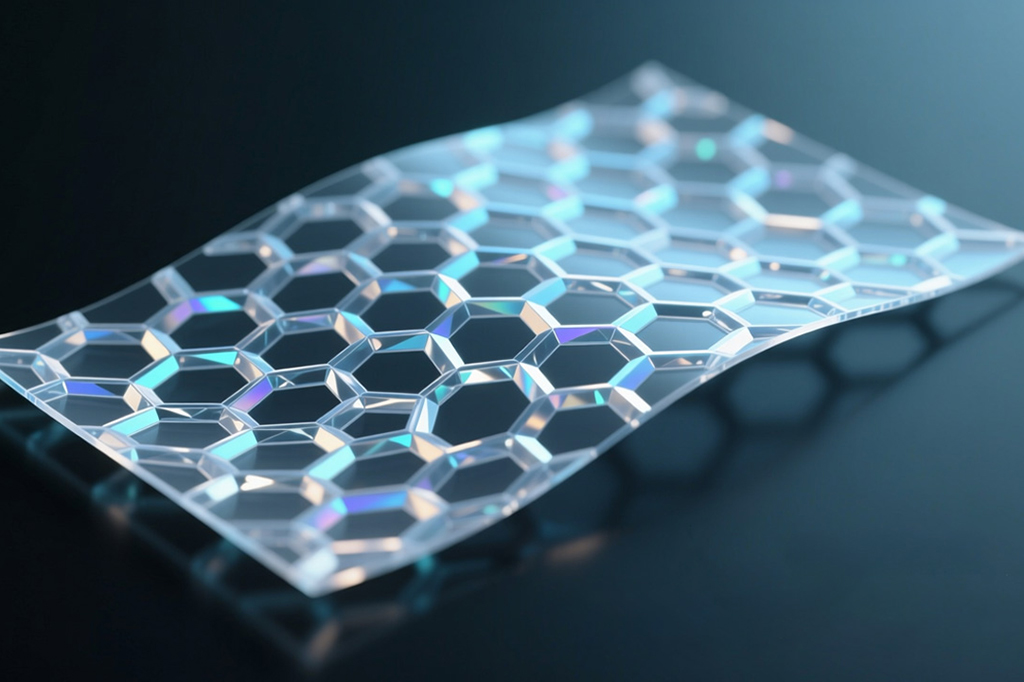
Researchers at Amirkabir University of Technology have succeeded in designing a nanocomposite membrane based on cellulose nanocrystals (CNCs) that can simultaneously improve three key parameters in water desalination, mechanical strength, water permeability, and salt rejection, a long-standing bottleneck in membrane technology.
According to the report, by carefully investigating the aspect ratio of cellulose nanocrystals and their loading level, the researchers created a pervasive interconnected network (PIN) that reproduces metamaterial-like behavior within the membrane. This network forms orderly and controlled pathways for water transport while preventing excessive structural opening that would otherwise reduce salt rejection. The results show that a loading of 0.50 wt% high–aspect-ratio CNCs provides the optimal configuration, significantly enhancing the performance of membranes for brackish water desalination.
The global freshwater crisis has driven countries for years to develop more efficient desalination technologies. With rising demand for drinking and industrial water, polymeric membranes have become one of the most important separation tools in water treatment. However, these membranes face a persistent challenge: achieving simultaneous improvements in mechanical strength, water permeability, and salt rejection. Enhancing one of these properties typically compromises another, and this inherent trade-off has long limited industrial progress. Identifying a structure capable of improving all three parameters at once has therefore been a major goal of membrane research over the past decade.
To address this challenge, a team of researchers at Amirkabir University of Technology studied the properties of cellulose nanocrystals and their arrangement within a polymer matrix, leading to the development of a new nanocomposite membrane capable of overcoming this historical limitation. The base material of the membrane is cellulose diacetate (CDA), a stable, accessible polymer well suited for separation applications. The key component of the study is cellulose nanocrystals—structures derived from natural cellulose that offer high aspect ratios, remarkable mechanical strength, and large active surface areas, making them widely attractive in nanoscience.
The role of the nanoscale component in this project lies primarily in how the CNCs are arranged and configured within the membrane. The researchers demonstrated that the mere presence of nanoparticles is insufficient; rather, the type of network formed by these nanorods ultimately determines the material’s final properties. Two factors—the CNC aspect ratio and weight fraction—govern the formation of different networking and entanglement patterns, ranging from random dispersion to the creation of a continuous, interwoven network.
In this study, four CNC loadings—0.15, 0.25, 0.50, and 0.75 wt%—were examined for high–aspect-ratio CNCs. Mechanical, viscoelastic, and separation tests showed that at lower loadings (0.15 and 0.25 wt%), CNCs remain dispersed or form a tight but limited network. However, at loadings of 0.50 wt% and above, a new structure emerges—a pervasive interconnected network (PIN). This continuous and extensive nanorod network not only enhances membrane strength but also alters the dynamic transport behavior of molecules and ions. In conventional membranes, increasing water flux typically reduces salt rejection or necessitates greater membrane thickness for stability. In contrast, the membrane developed at Amirkabir University, containing an optimized 0.50 wt% of high–aspect-ratio CNCs, creates dual, controlled pathways for water transport. These so-called bi-continuous pathways play a crucial role in regulating ion transport, as confirmed by electrostatic and physical analyses.
The presence of this network also makes the membrane more resistant to pressure fluctuations and mechanical loading. Enhanced mechanical strength enables the membrane to operate under higher pressures without structural failure—an especially important advantage in brackish water desalination processes, where operating pressures are relatively high.
To further understand the behavior of this network, the researchers employed linear and nonlinear viscoelastic tests, which revealed that at higher loadings, CNCs transition from a dispersed state to a stable, interconnected network. Analysis of the mechanical reinforcement efficiency factor (CFE) also showed that a 0.50 wt% CNC loading yields the most significant improvement in strength relative to the base polymer, without causing excessive aggregation or blocking transport pathways.
Beyond demonstrating simultaneous improvement of the three key performance indicators, this research shows that by engineering the dispersion state of nanorods within a polymer, it is possible to create a material with metamaterial-like behavior—where properties arise not only from the constituent materials themselves, but from their organization at the nanoscale.
Overall, the results indicate that nanocomposite membranes containing 0.50 wt% high–aspect-ratio CNCs deliver optimal performance in brackish water treatment and could serve as a foundation for the development of next-generation industrial membranes. The study highlights how a deeper understanding of nanoscale network structures can overcome conventional limitations and lead to more durable, efficient, and robust desalination membranes.
The findings of this project have been published in an article titled “Does pervasive interconnected network of cellulose nanocrystals in nanocomposite membranes address simultaneous mechanical strength/water permeability/salt rejection improvement?” in the journal Carbohydrate Polymers.